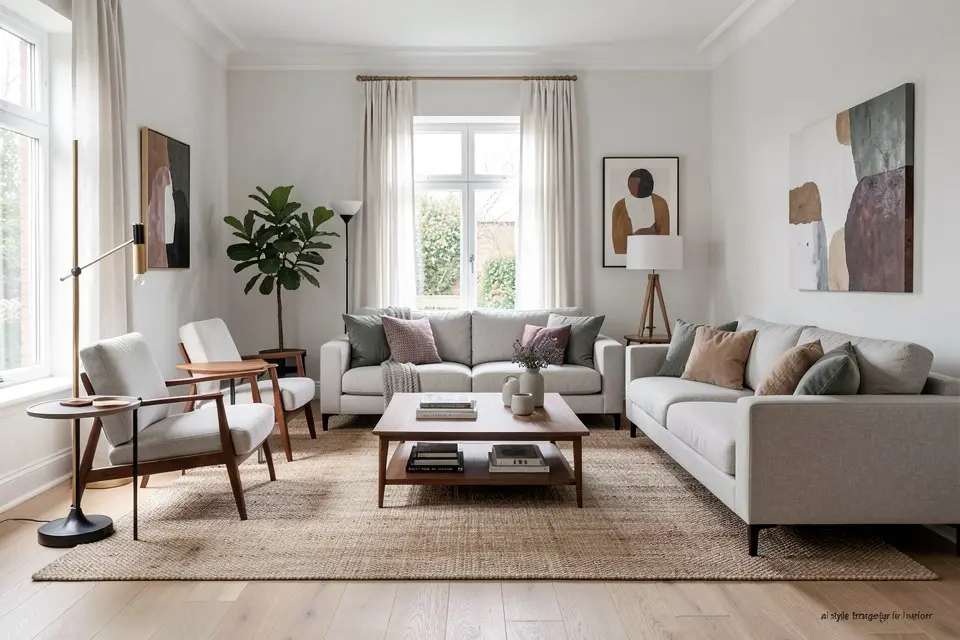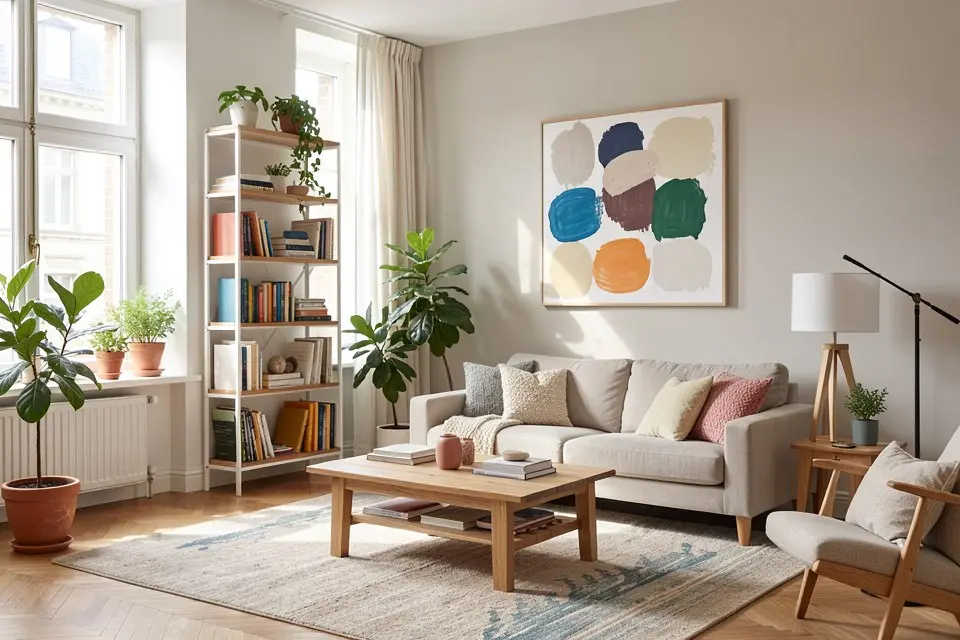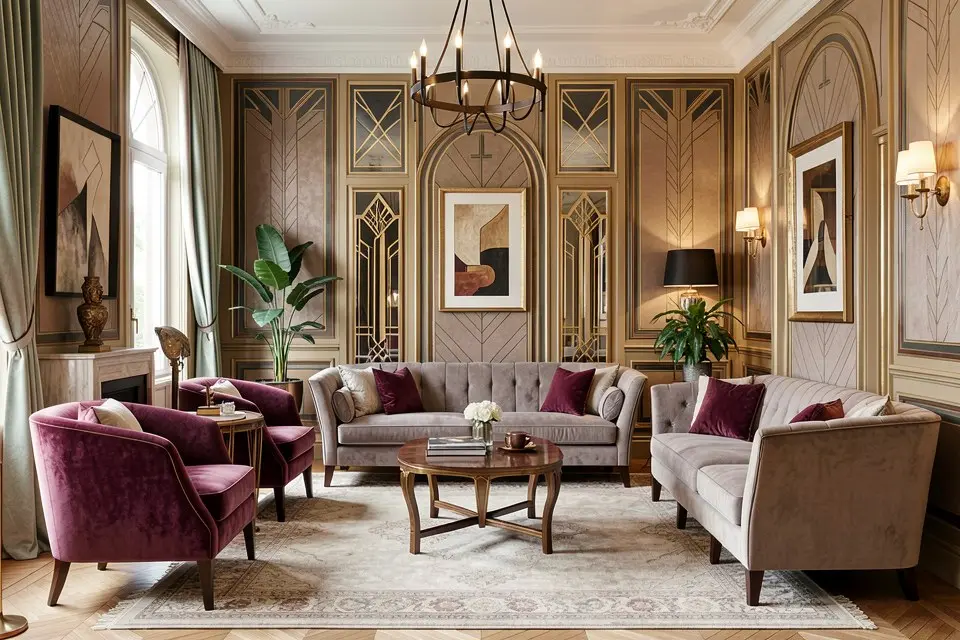
Art deco is geometric symmetry, jewel-tone colour, and metallic accents used with total confidence, not scattered gold trim on otherwise plain furniture. The style demands commitment to a motif; half-hearted deco just looks like expensive furniture with brass handles.
What defines the era
Art deco emerged in the 1920s and 30s from a specific optimism about machinery, speed, and luxury, skyscrapers, ocean liners, and industrial glamour all feeding the same visual language: sunburst and chevron motifs, symmetrical layouts, and materials that shine, lacquer, mirror, brass, marble. The style is precise and symmetrical by nature, which is the opposite instinct of a boho or farmhouse room, and that precision is what makes it read correctly or fall apart.
The five markers
- Geometric repetition: chevron, sunburst, or stepped motifs repeated in a rug, a mirror frame, or a light fixture.
- Jewel-tone colour: emerald, sapphire, burgundy, or black as a dominant or secondary colour, never pastel.
- Metallic accents, brass or gold, on hardware, mirror frames, and lighting.
- Lacquer or high-gloss surfaces on at least one furniture piece, a sideboard or console.
- Strict symmetry in furniture arrangement: matched lamps, matched chairs flanking a piece, centred artwork.
The palette
| Element | Colour |
|---|---|
| Walls | black, deep emerald, or warm white as a backdrop |
| Furniture | lacquer or velvet in a jewel tone |
| Metal | brass or gold, used consistently, not mixed with chrome |
| Accent surface | marble or mirror |
Where it goes wrong
The most common failure is scattering gold trim across furniture that has no other deco DNA, a plain sofa with gold-tipped legs, a plain mirror with a thin gold frame. Without the geometric motif and the jewel-tone colour behind it, the gold reads as generic “glam” decor rather than art deco specifically.
The second failure is asymmetry. Deco relies on formal balance: a console centred under a mirror, two matching lamps, a symmetrical furniture arrangement. A deco-styled room with furniture placed the way you’d arrange a casual living room undercuts the whole effect. If you’re not sure your room’s layout can support that symmetry, it’s worth mapping the fixed points first the way how to redesign any room describes, since deco is far less forgiving of an off-centre window or an awkward door swing than more casual styles.
Room by room
- Living room: a velvet sofa in emerald or sapphire, a lacquered black coffee table, a brass-framed sunburst mirror centred on the main wall, symmetrical table lamps.
- Dining room: a lacquer or marble-top table, chairs upholstered in a jewel tone with brass legs, a geometric pendant light centred above the table.
- Bathroom: black-and-white geometric floor tile, brass fixtures, a scalloped or fan-shaped mirror.
- Home office: a dark lacquer desk, a brass desk lamp, a single piece of geometric art centred behind the chair.
Deco’s high-contrast palette is a close cousin of maximalist style; if the symmetry feels too formal for your home, transitional style borrows the polish without the drama.
A worked example
A 3.8 × 4.5 m living room currently plain: beige walls, a taupe sofa, no metallics, mismatched lamps.
One accent wall, ideally the one the seating faces, gets painted deep emerald (the accent wall ideas guide covers why the wall the seating faces is the right one). The taupe sofa is reupholstered or replaced in a jewel-toned velvet. The mismatched lamps are replaced with a matching brass pair, placed symmetrically on either side of the sofa or a console. A single sunburst mirror in brass goes above the console, centred. The existing coffee table gets swapped for a lacquered or mirrored one if budget allows. Total cost: €1,500 to €4,200, with the wall paint and the sofa as the two anchor decisions.
Try it yourself
Because deco reads as more formal and higher-contrast than most residential styles, it pairs oddly with a low renovation budget; check the realistic numbers in interior painting cost guide before committing to a full jewel-tone wall, and check the chip’s undertone under your own light, as choosing paint colours by undertone explains, since emerald swings blue or yellow depending on the base. To test whether your room can carry deco’s symmetry and colour, run Style Transfer in Homie on a photo of the space. It keeps your window and door positions fixed while showing the jewel-tone palette and brass accents, so you can judge the symmetry before buying a matching lamp pair.