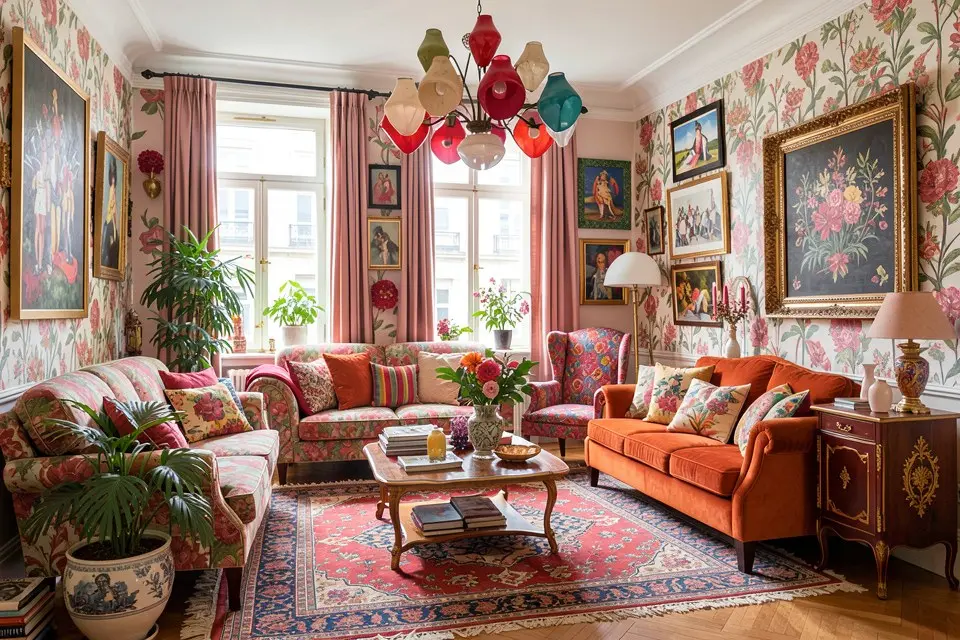
Maximalist interior design is bold pattern and colour organised by a repeating logic, not just a lot of stuff. The difference between a maximalist room and a cluttered one is whether there’s a rule underneath the confidence, even if that rule is invisible at first glance.
The organising principle
Every maximalist room that actually works has one of three anchors holding it together: a repeated colour that shows up across otherwise unrelated patterns, a single dominant pattern scale that everything else is sized relative to, or a curated collection (art, ceramics, books) that gives the eye a category to recognise rather than a jumble to parse. Remove the anchor and the same objects become clutter. This is why maximalism is often harder to do well than minimalism, there’s no empty space to hide an unresolved decision in.
The five markers
- A repeated anchor colour across at least three different elements, wallpaper, upholstery, art, even if each item’s other colours differ.
- Layered pattern at different scales: a large-scale wallpaper with a small-scale cushion print, never two patterns of the same scale competing.
- A gallery wall or curated collection, displayed with intention, aligned edges or a considered grid, not scattered.
- One neutral resting surface: a plain floor, a plain ceiling, or one unadorned wall.
- Confident, saturated colour, used without apology, jewel tones, deep colour-drenched walls, or a bold wallpaper. Art deco is the disciplined, symmetrical cousin of this same jewel-tone palette.
The palette
Maximalism doesn’t have a fixed palette the way most styles do, but a working room usually follows this structure:
| Element | Role |
|---|---|
| One saturated wall or wallpaper colour | anchor |
| Two to three secondary colours | repeated in textiles and art |
| One neutral surface (floor, ceiling) | resting point |
| Metallics (brass, gold) | connective tissue across patterns |
Where it goes wrong
The most common failure is having no anchor at all: a floral sofa, a striped rug, a geometric lamp, and a plaid cushion with nothing tying them together. Individually confident, collectively noise. The fix is to pick one colour before buying anything and make sure it recurs in at least three places.
The second failure is skipping the resting surface. A maximalist room with pattern on every wall, the floor, and the ceiling gives the eye nowhere to land and becomes exhausting rather than energising. Keeping one plain surface, even just the ceiling in a flat white, makes the rest of the room readable. This is the same balancing logic bohemian style uses with its narrower earth-tone palette; maximalism just widens the colour range while keeping the same underlying discipline.
Room by room
- Living room: one bold wallpapered wall (see accent wall ideas for which wall to pick), a patterned sofa in a coordinating anchor colour, a gallery wall of mixed-era art, a plain floor to rest the eye.
- Dining room: a saturated wall colour, a patterned rug, mismatched chairs unified by the anchor colour on their cushions.
- Bedroom: a bold wallpaper as a headboard wall, layered patterned textiles in the anchor colour family, plain white ceiling. Check bedroom redesign ideas if pattern-heavy walls need to be balanced against actual sleep-quality lighting.
- Powder room: the easiest room to go fully maximalist in, since the small footprint limits cost. A bold wallpaper, a statement mirror, and a saturated vanity colour.
A worked example
A 3.4 × 4.2 m dining room currently plain: white walls, a plain wood table, mismatched chairs with no unifying colour.
A deep emerald or berry wallpaper with a large-scale botanical print goes on the main wall as the anchor. The existing mismatched chairs stay, reupholstered or slipcovered in a single coordinating colour pulled from the wallpaper, which instantly unifies them without buying new ones. A patterned runner replaces a full rug so the floor stays mostly visible as the resting surface. A gallery wall of small framed prints, all in the anchor colour’s family, fills the remaining wall. Total cost: €800 to €2,400, with wallpaper and reupholstery as the main spend.
Try it yourself
If pattern-heavy walls are the part you’re unsure about, it’s worth testing the wallpaper commitment before buying a full roll; the same logic applies to testing any bold colour decision the way how to generate a paint colour palette recommends for a single wall. To see a maximalist treatment on your own room, run Style Transfer in Homie on a photo of the space. It keeps your layout fixed and shows the anchor colour and pattern layering in place, so you can judge whether it holds together before ordering wallpaper.