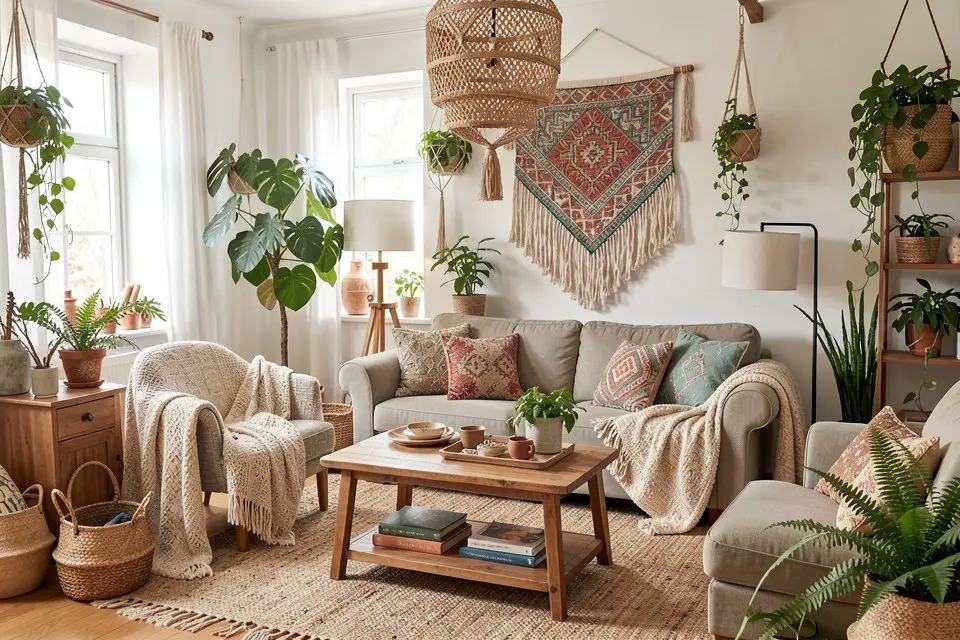
Bohemian style is layered pattern and natural material inside a disciplined earth-tone palette, not “every thrifted object I own in one room.” The word that actually separates good boho from cluttered boho is discipline, not accumulation.
The rule people skip
Boho looks unplanned, but the ones that photograph well are built on a tight colour logic: two or three earth tones, repeated across every layer. Rust, terracotta, mustard, and deep green show up again and again in a well-done boho room, on the rug, the cushions, the throw, the art, rather than every colour in the spectrum appearing once. The pattern mixing works precisely because the palette underneath it is narrow.
The five markers
- Layered textiles in a shared palette. Two or three rugs overlapping, cushions in different patterns but the same colour family.
- Natural fibre everywhere. Rattan, jute, macramé, unbleached cotton. This is the material family that separates boho from just “colourful.”
- Real plants at different heights, floor, shelf, hanging, not scattered decoratively but placed with actual light needs considered.
- Global and vintage objects with a story: a kilim, a hand-thrown ceramic, a piece of woven wall art, not mass-produced “ethnic print” decor.
- Warm, low lighting, string lights, a Moroccan-style lantern, or a warm-bulb floor lamp rather than bright overhead light.
The palette
| Element | Colour |
|---|---|
| Base | warm white or natural linen |
| Textiles | rust, terracotta, mustard, deep green |
| Wood | warm, aged, or reclaimed tone |
| Metal | brass or aged copper |
Where it goes wrong
The main failure is colour sprawl: turquoise, hot pink, orange, and purple all in the same room because each individually is “boho.” Without a shared palette anchoring them, it reads as a thrift-store clearance rack rather than a designed room; even maximalist rooms, which use far more colour than boho, hold to a repeated palette. The fix is to pick two to three colours before buying anything and check every new textile against that list.
The second failure is plant overload without plant health. Six dying plants in random pots is clutter, not boho. Three or four thriving plants, chosen for the room’s actual light, do more work than twice as many struggling ones. If the room genuinely lacks light for that many plants, it’s worth confirming with a look at the space’s real light levels before buying, which overlaps with the fixed-point exercise in how to redesign any room.
Room by room
- Living room: a rattan or wood-frame sofa with two overlapping rugs, a gallery wall of vintage or textile art, hanging plants near the window.
- Bedroom: a macramé or rattan headboard, layered textile bedding within the earth-tone palette, a Moroccan-style pendant or lantern. Cross-reference with bedroom redesign ideas if the room’s light and layout haven’t been assessed yet.
- Home office: a rattan chair, a woven wall hanging behind the desk, one strong patterned rug to anchor the space.
- Dining room: mismatched chairs in a shared wood tone, a runner instead of a full tablecloth, a low-hanging woven pendant.
Boho’s layering sits at the opposite end of the spectrum from minimalist design; if you want the colour without the clutter, transitional style is the calmer middle ground.
A worked example
A 3.5 × 4 m bedroom currently beige and empty: beige walls, a plain grey duvet, no textiles, one unhealthy plant on the windowsill.
The walls stay neutral, boho relies on textiles for colour, not paint, so a warm white is fine as-is. A kilim-style rug goes down, layered slightly under a smaller jute rug at the foot of the bed. The duvet is swapped for one in a rust-and-cream pattern, with two mismatched cushions in mustard and deep green pulling from the same family. Two healthy plants replace the struggling one, one on the floor in a woven basket planter, one hanging near the window. Total cost: €400 to €1,100, almost entirely textiles and plants, no furniture replacement required. The same textile-first logic drives most of the small-budget room makeover playbook.
Try it yourself
Boho depends heavily on getting the textile layering right before buying, which is exactly the kind of decision worth testing visually first. Run Style Transfer in Homie on a photo of your room to see the earth-tone palette and layered textiles applied to your actual space, keeping your walls and windows fixed, before you buy a single rug.