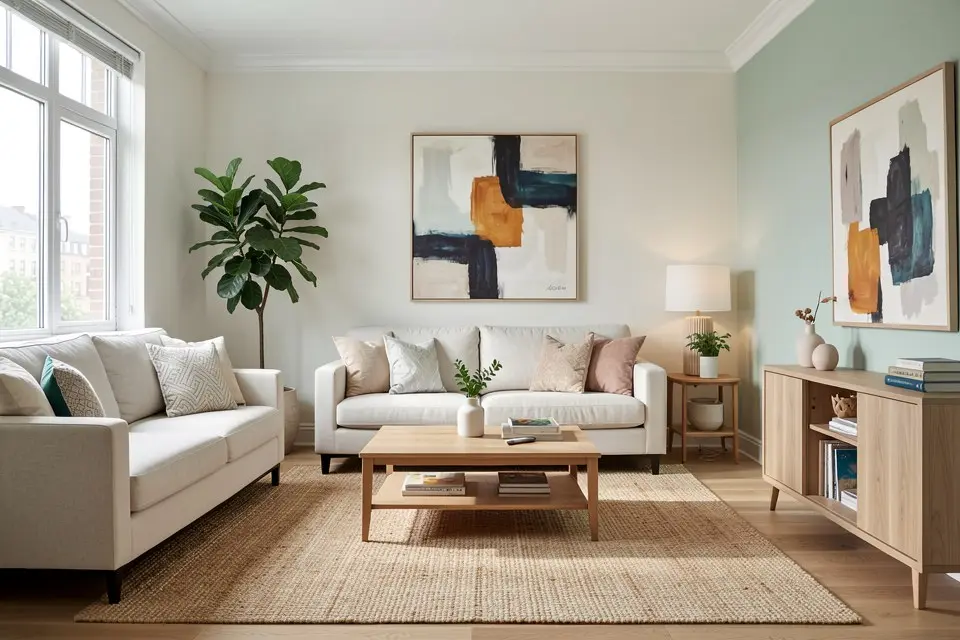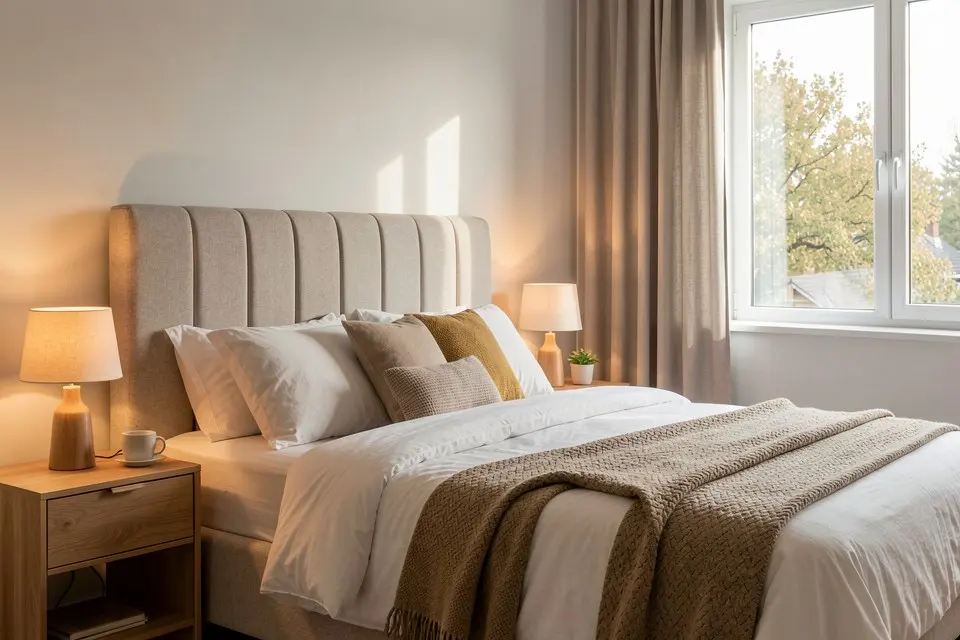
An accent wall works when it sits behind the room’s main object, runs the full width uninterrupted, and is darker or more textured than the other three walls. It fails when it is chosen because a wall happened to be empty. In most homes that is the whole difference between the accent walls that look intentional and the ones that look like somebody ran out of paint.
Pick the wall by what is in front of it, not by what is on it
The accent wall is a backdrop. So the question is not “which wall is boring?” but “which wall has the thing I want people to look at?”
- Bedroom: the headboard wall. Almost always. A dark or textured wall behind a bed makes the bed read as larger and the ceiling as higher, which is why it appears in most bedroom colour schemes that use any strong colour at all.
- Living room: the wall the sofa faces if the TV or fireplace is there, or the wall behind the sofa if the sofa is the focal point. Not both.
- Dining room: the wall you see from the doorway, behind the long side of the table.
- Hallway or entry: the wall at the end of the sightline, which is the one wall where a lighter accent can work because it pulls the eye down the corridor.
Rule out any wall with a door in it, a radiator across more than a third of it, or two windows. Paint stops at trim, and every interruption is a place for the eye to lose the shape. One window centred on the wall is fine; it becomes part of the composition.
It should also be a wall you see square-on from where you sit; a wall seen at 20° from the sofa gives you the cost and none of the effect.
Colours that hold up
Take the room’s existing wall colour and go 3–5 steps deeper on the same card, or pick a different colour of the same depth. Two things go wrong with accent wall colour in most homes, and both are avoidable.
The first is going too bright. A saturated accent — cobalt, emerald, fire-engine red — works in photographs at 3pm and looks like a school corridor at 9pm under a warm bulb. Muted versions of the same colours (inky navy, bottle green, oxblood) survive both.
The second is ignoring the undertone of the other three walls. A cool grey-green accent against warm cream walls looks dirty; the same green against a cool off-white looks expensive. The undertone method for choosing paint takes 10 minutes and is the step people skip before repainting a wall twice.
Colours that typically work as a single accent wall, from safest to boldest:
- Deep warm neutral — mushroom, clay, tobacco. Works with almost any furniture.
- Ink navy or charcoal — behind a bed or a light sofa. Needs a warm light source.
- Green, dark and grey-leaning — olive, forest. Best with wood and brass.
- Terracotta or rust — behind a dining table, or a sofa in a north-facing room.
- Plaster pink or ochre — only with plenty of daylight and white trim.
Test the colour before you commit: a 50 × 50 cm sample on the actual wall, viewed morning and evening, or a photo of the room run through Room Redesign in Homie with the wall recoloured, which is faster than three sample pots at €5 each.
Paint vs panelling vs wallpaper
| Method | Materials (3 × 2.5 m wall) | Time | Reversible? | Best for |
|---|---|---|---|---|
| Flat colour paint | €25 – €60 | 3–4 hours incl. two coats | Yes, repaint | Any room, first attempt |
| Limewash or plaster-effect paint | €60 – €140 | 4–6 hours | Repaint, needs primer | Bedrooms, hallways |
| Peel-and-stick wallpaper | €60 – €200 | 2–3 hours | Yes, peels clean | Rentals, kids’ rooms |
| Paste-the-wall wallpaper | €80 – €350 | 3–5 hours | Strippable, patchy | Dining, bedroom |
| MDF slat panelling | €150 – €450 | A day, plus paint | No, leaves holes | Behind beds, TV walls |
| Shaker or board-and-batten | €120 – €300 | A day, plus caulk and paint | No | Dining rooms, entries |
| Fitted panelling (trade) | €400 – €1,200 | Half a day for them | No | When you want it perfect |
Paint is the right first answer in most rooms. It is the cheapest test of the idea, and if the wall is wrong, you learn it for €40. Wallpaper adds pattern and texture that paint cannot, but a wall with pattern on it needs plainer furniture in front of it. Panelling is the only option that changes the wall’s relief rather than its surface, and it is the one that reads as “built in” rather than “decorated” — which is why it holds value best in a sale, and why staging advice for sellers tends to favour it over any wallpaper.
If the wall is part of a wider repaint, the interior painting cost guide covers trade prices per room versus DIY.
Materials beyond paint that actually work
- Vertical slats (20–40 mm wide, 15–30 mm gaps) on a painted backing board. Behind a bed, running floor to ceiling. Paint the slats and the backing the same colour; two-tone slat walls date fast.
- Half-height panelling at 90–110 cm with a darker colour below and lighter above. This is the one place an accent wall can wrap two walls without losing its shape.
- Micro-cement or plaster for a bathroom or entry. €80–€200 per m² fitted, so it is a small-wall material.
- Full-height bookshelves painted the wall colour. Storage that is also the accent wall is a better use of a small living room than either alone, and it is the layout trick the small living room layout guide leans on for square rooms.
Skip mirror tiles, brick-effect wallpaper and full-wall metallics: they live as glare.
When an accent wall is a mistake
Say no to the accent wall in these rooms, because it will make them worse.
- A room under 9 m² with the accent on the short wall. The dark short wall pulls forward and the room turns into a box. Paint all four walls the deeper colour instead — a small room in one dark colour reads as a jewel box, a small room with one dark wall reads as a cupboard.
- A room with a strong architectural feature already. A fireplace, an arched window, exposed beams. The accent wall competes with it and both lose.
- A room with no clear focal wall. Three doors, a corner window, an L-shape. If you cannot name the wall in five seconds, there is no accent wall to be had.
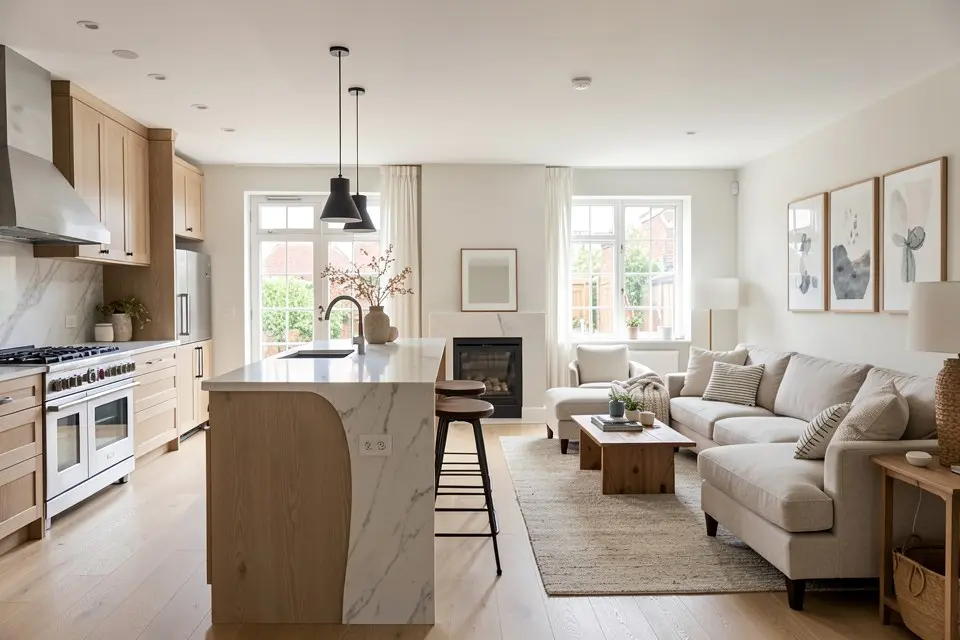
- Open-plan spaces where the “wall” is half a wall. A colour block that stops at a kitchen return looks unfinished. Zone with a rug and lighting instead.
- When it is the only design decision. An accent wall on its own, with the same furniture in the same places, is a coloured wall. It works when it is one of three or four moves — layout, lighting, one large textile — and looks like the whole plan when it is the only one. The five-step room redesign method is the order those moves go in.
A worked example
A 3.4 × 3.8 m bedroom, off-white walls, bed on the 3.4 m wall opposite the door with a window to the right of it. The window is off-centre, so the headboard wall is not a clean rectangle.
The answer is half-height slat panelling at 110 cm across the full 3.4 m, painted a deep olive, with the wall above staying off-white. The panelling stops at the window reveal, which reads as deliberate because the horizontal line carries through. Above it, one 80 × 100 cm artwork centred on the bed. Bedside lamps with warm 2700 K bulbs so the olive stays green at night. Materials: €190 for MDF slats and a backing board, €45 for paint, one Saturday. The bed, curtains and floor did not change, and the room now has a front.