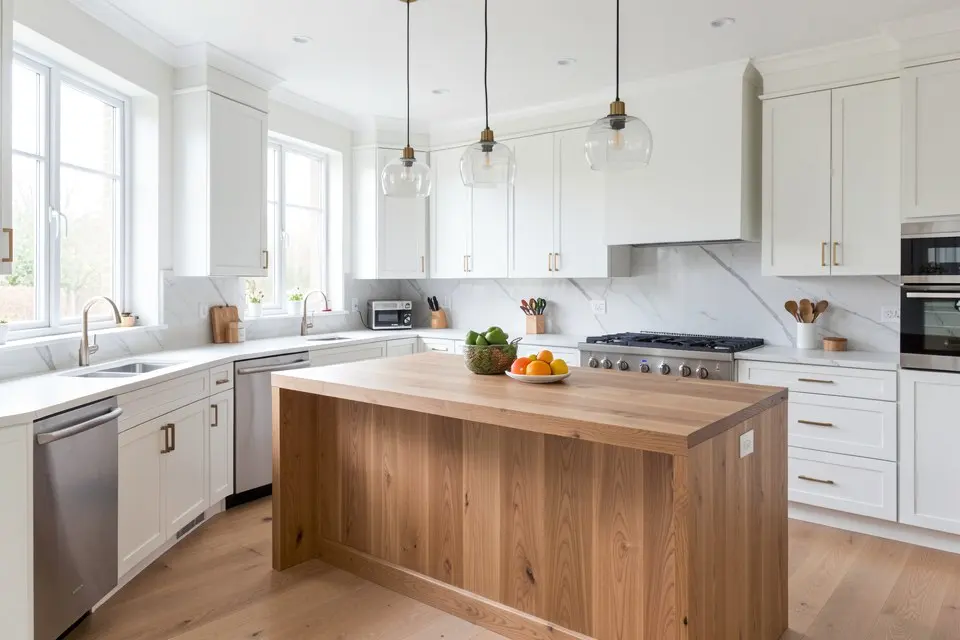
Painting kitchen cabinets takes four to five days for a typical kitchen of 15 – 20 doors and drawer fronts, and about €150 – €400 in materials. The paint is the easy part. What decides whether the finish lasts ten years or chips in ten weeks is degreasing, a scuff sand and a primer chosen for the surface underneath.
First: can your cabinets be painted?
| Surface | Paintable? | Primer |
|---|---|---|
| Solid wood or veneer | Yes | Stain-blocking primer (shellac or alkyd) on oak and pine, which bleed tannin |
| MDF, previously painted | Yes | Standard water-based adhesion primer |
| Melamine / laminate | Yes, with care | Adhesion primer made for laminate, or a 2-component primer |
| Thermofoil (vinyl wrap) | Rarely | Peeling or bubbling foil will lift again; replace the doors |
| High-gloss acrylic | Rarely | Needs sanding through the gloss; doors are often cheaper |
If the foil is lifting at the edges or the doors are swollen near the sink, painting will not fix it. Replacing doors only on existing carcasses costs €1,500 – €5,000 for a mid-size kitchen, still a fraction of new cabinets.
What you need
- Degreaser (sugar soap or a dedicated cabinet cleaner) and lint-free cloths
- Abrasive pads or paper in 120 and 180 – 240 grit
- Primer for your surface: about 1 litre for 15 – 20 doors, €25 – €50
- Cabinet enamel — water-based alkyd or polyurethane-acrylic: 2 litres for two coats, €60 – €160
- A 10 cm foam or microfibre roller, a 5 cm angled synthetic brush
- Wood filler, masking tape, a drill and labelled bags for the hinges
Budget around €150 – €400 in total. The paint is the line worth spending on: cheap wall emulsion on cabinets stays soft and sticky and marks where hands touch.
Step by step
- Empty, label, remove. Take off doors, drawer fronts, hinges and handles. Number each door and its opening with tape inside the hinge hole so everything goes back in place.
- Degrease properly. Kitchen grease is the main reason paint fails. Wash every surface twice with degreaser, rinse with clean water and let it dry fully.
- Fill and sand. Fill dents and old handle holes if you are changing hardware. Scuff everything with 180 – 240 grit — you are dulling the surface, not stripping it. Vacuum and wipe off the dust.
- Prime. One thin coat of the primer matched to your surface. Wait the full recoat time on the tin, then sand lightly with 240 grit.
- Paint the frames first. Brush the edges and recesses, then roll the flat faces in one direction. Doors go flat on supports so the paint levels instead of running.
- Two thin coats, not one thick one. Wait 16 – 24 hours between coats. Thick coats sag, stay soft and take weeks longer to harden.
- Rehang after 48 hours. Fit soft bumpers on the doors so painted surfaces don’t stick together while the paint cures, which takes two to four weeks.
Costs: DIY, painter or spray shop
| Route | Typical cost (15 – 20 fronts) | Finish | Time without a kitchen |
|---|---|---|---|
| DIY, brush and roller | €150 – €400 | Good, faint roller texture | 4 – 5 days |
| Painter on site | €900 – €1,800 | Very good | 3 – 4 days |
| Doors sprayed in a workshop | €1,200 – €3,500 | Factory-like | 1 – 2 days on site |
| New doors on existing carcasses | €1,500 – €5,000 | New | 1 day to fit |
New cabinets for the same kitchen typically start at €6,000. If you can’t decide between doing it yourself and paying for spraying, DIY vs hiring a contractor breaks down when the time saved is worth the money, and what it costs to paint a room puts cabinet painting alongside the walls if you’re doing both.
The mistakes that make paint peel
- Skipping the degreaser because the doors “look clean”. They aren’t.
- Wall paint on doors. It never hardens enough for a surface you touch fifty times a day.
- No stain-blocking primer on oak. Tannin bleeds yellow through white paint within weeks.
- Rehanging too early. Doors closed on soft paint stick, and pull off a patch when opened.
- Painting hinges and runners. They stop closing smoothly; mask or remove them.
Choosing the colour
Pick the colour against the floor and worktop you’re keeping, not against a sample card. Kitchen cabinet colour ideas covers which shades age well and the two-tone rule (darker colour on the bottom, no more than 40 percent of the cabinet area), and how to choose paint colours by undertone explains why a white can look grey or yellow next to your tiles. If you rent, check with the landlord first — rental-friendly upgrades lists reversible alternatives such as adhesive film and new handles.
Painted cabinets are the biggest single change in a kitchen redesign without renovation: once the colour is set, handles, backsplash and lighting fall into place around it.
See the colour on your own kitchen first
Two weekends is a lot of work to discover a green looks muddy against your floor. Take a photo from the doorway with both cabinet runs in frame and use Homie’s Room Redesign to try two or three colours on your actual kitchen; designing a kitchen with AI shows the prompts that keep the layout fixed and change only the cabinet colour.
 Homie