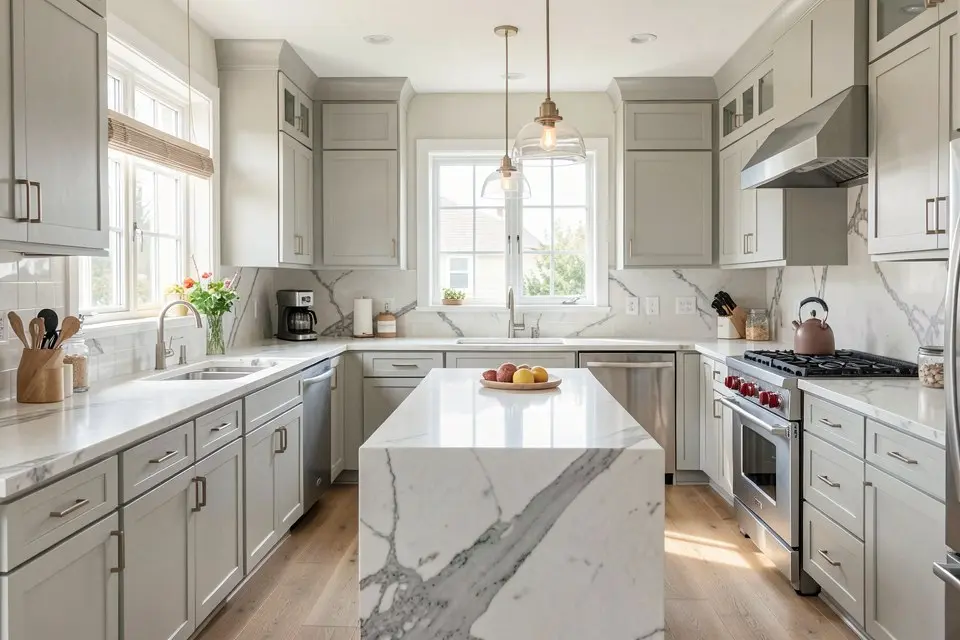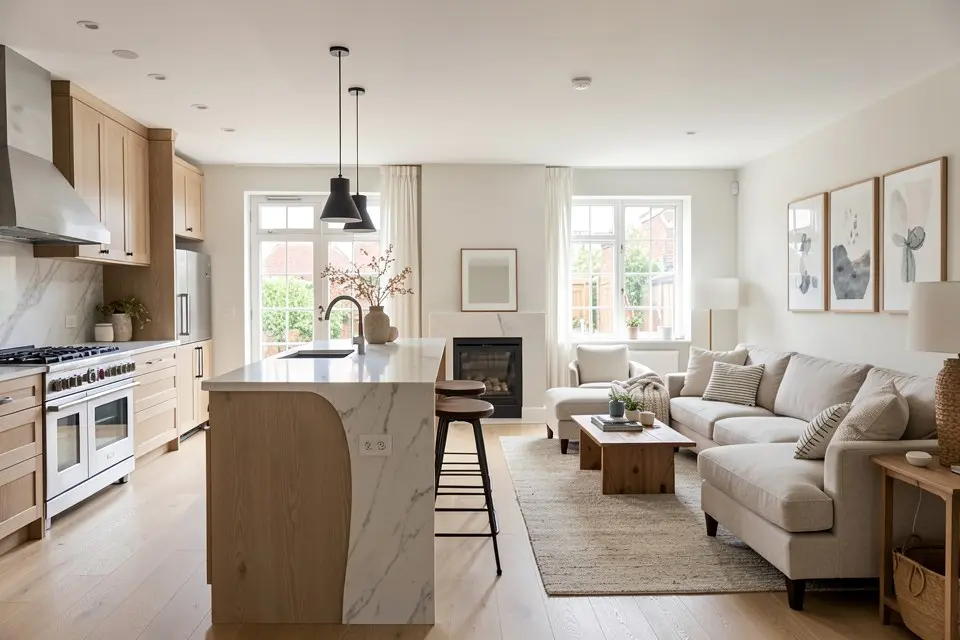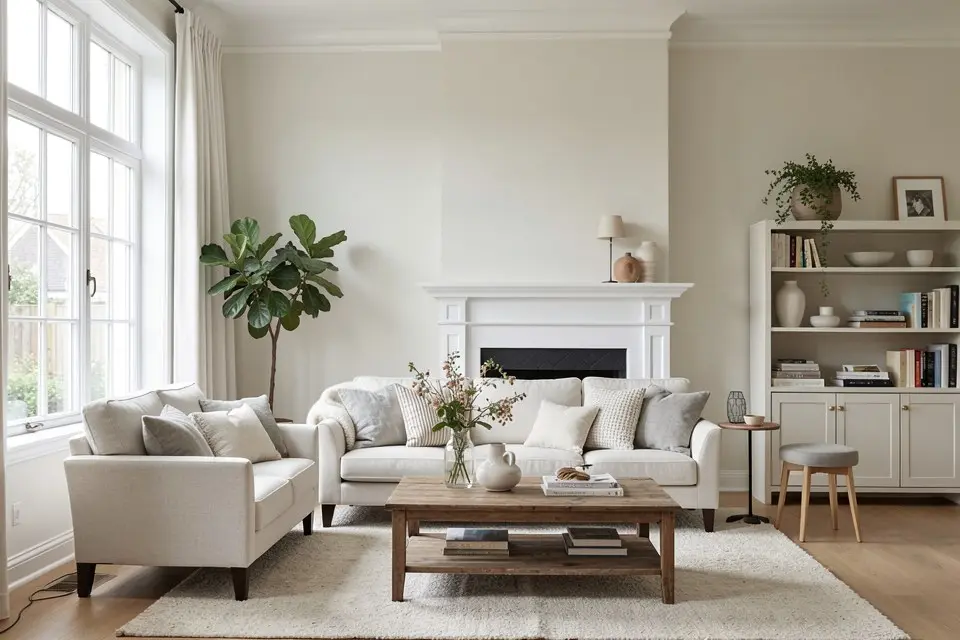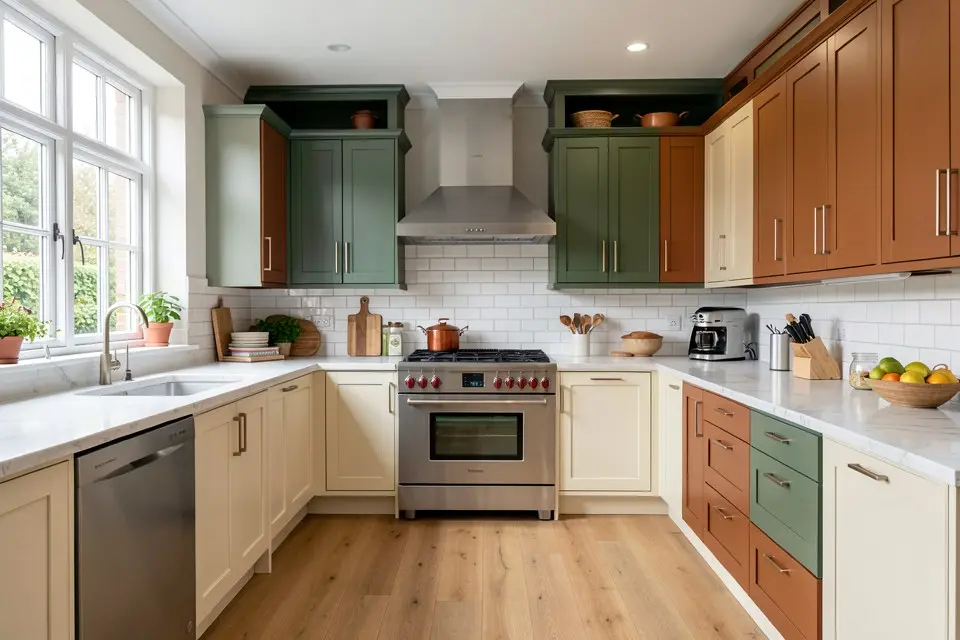
The kitchen cabinet colours that hold up are the ones that get along with everything else in the room: warm white, a mid-tone wood, and a greyed-down green or blue. Trend colours fail not because they are ugly, but because they refuse to cooperate with the next countertop, the next floor, or the next owner.
Cabinets are the largest continuous colour surface in most kitchens — typically 8 to 14 m² of door fronts in a mid-size galley or L-shape — and they outlast every other finish. Paint on walls gets redone every 5–7 years. Cabinets get touched once a decade at best. That timescale is the whole argument below.
Colours that age well, and why
Three families keep working across the changes a kitchen goes through.
- Warm whites and off-whites. Not brilliant white, which turns every wood floor yellow by comparison and shows every scuff. A white with a drop of yellow or grey in it. It pairs with light stone, dark stone, wood and tile, which is why it is the default in most rental kitchens and most well-resolved expensive ones.
- Mid-tone wood. Oak, ash, walnut veneer — left as wood, not stained orange. Wood is the only cabinet finish that hides fingerprints, hides small chips, and looks better with wear rather than worse. Its risk is being too much of it; in most homes a fully wooden kitchen needs a pale floor and a pale worktop to breathe.
- Muted green, blue and grey-green. The chalky, greyed versions: sage, eucalyptus, slate blue, olive. These carry enough grey to behave like a neutral but enough colour to make the kitchen feel designed. They pair with brass, black and stainless equally well, which is unusual.
If you want a reference point for how these tones sit inside a full palette, the Scandinavian style guide and the farmhouse style guide both lean heavily on the first two families and are good evidence that they wear well over many years.
Trend colours, honestly
Trend colours are not a mistake; buying doors in them is. Any colour that was suddenly everywhere in a two-year window — pure black, deep navy, forest green, terracotta, “greige” in its flattest form — will date to that window.
The rule I use: a trend colour is fine if it costs under €400 to remove. That means paint, never new doors. If you repaint in a colour that goes out of favour, you repaint again for a weekend of work. If you spend €4,000 on navy doors, you are living with navy for ten years or eating the loss.
Two colours I would push back on even as paint:
- Pure black cabinets in kitchens under 12 m² or with a north-facing window. They eat light and the room needs at least 4 light sources to compensate.
- Cool grey with a warm floor. The most common mismatch; the grey reads dirty next to oak or pine.
Two-tone cabinets: the rules
Two-tone kitchens work when they follow three constraints, and look like a compromise when they do not.
- Dark low, light high. The darker colour goes on base units, the lighter on wall units or open shelving. The reverse makes the kitchen top-heavy and the ceiling drop.
- Keep the dark colour to 40 percent or less of the visible cabinet area. An island in the second colour plus pale runs on the walls is the version that works in most homes. Dark bases and dark island with only three light wall units is not two-tone; it is a dark kitchen with an afterthought.
- Match undertones. Both colours warm, or both cool. Warm white uppers with sage bases works. Cool white uppers with olive bases fights.
A fourth, optional rule: put the wood in one place only. Wood island with painted runs, or wood runs with a painted island. Wood in both is a heavy kitchen.
Pairing cabinets with countertop and floor undertones
This is where most kitchens go wrong, and it is a five-minute check. Every stone, laminate, wood and tile has an undertone — a lean toward yellow, pink, grey, green or blue that is obvious next to a pure white sheet of paper.
- Warm floor (oak, pine, honey-toned laminate): cabinets in warm white, sage, olive, or a greyed navy. Avoid cool grey and blue-white.
- Cool floor (grey tile, grey-washed wood, concrete): cabinets in cool white, slate blue, charcoal, or a wood with a grey cast. Avoid cream.
- Warm countertop (butcher block, cream quartz, beige granite): warm white, mid green, or wood cabinets.
- Cool countertop (white quartz with grey veining, black granite, stainless): almost anything, but pull one undertone from the veining and let the cabinet follow it.
Fixed surfaces set the undertone; cabinets follow. If you are keeping the floor, the floor decides. The method for finding an undertone with a white sheet and daylight is laid out in how to choose paint colours by undertone and applies exactly the same to cabinet paint.
Pick the door colour last, after floor and worktop are decided — the same buy-last logic as in how to redesign any room. If the whole kitchen palette still feels loose, run the photo through a generated paint palette and check that the cabinet colour, wall colour and floor all sit in the same warm or cool half.
Repaint vs replace: what it costs
| Option | Typical range (15–20 doors) | Lifespan |
|---|---|---|
| DIY repaint, brush and roller | €150 – €400 materials | 4 – 7 years |
| Professional sprayed repaint | €1,200 – €3,500 | 8 – 12 years |
| New doors on existing carcasses | €1,500 – €5,000 | 15+ years |
| Full replacement, mid-size kitchen | €6,000 – €20,000 | 15 – 25 years |
Repaint if the carcasses are sound, the doors are flat or shaker (not thermofoil that is peeling), and the layout works. Replace doors only when the doors are damaged or you want a different profile. Replace everything when the layout is the problem — colour never fixes a layout.
DIY repaint is a 3–5 day job for a mid-size kitchen: 1 day to remove and degrease, 1 day to prime, 2 days for two coats with drying, plus rehanging. A sprayed professional finish is the only route that looks factory-made; brushed finishes always show a little texture up close, and in a bright kitchen that is visible.
If the cabinet colour is part of a wider refresh without changing the layout, kitchen redesign ideas without a renovation covers what else moves the needle for under €1,000.
Test the colour before committing
Paint two doors — one upper, one lower, in the corner that gets the least light — and live with them for a week. Cabinet colour shifts more than wall colour because door fronts are vertical, catch side light, and sit next to a worktop that reflects onto them.
Faster: photograph the kitchen from the doorway with floor and worktop in frame, and run Room Redesign in Homie with the cabinet colour you are considering. The result includes a paint palette and a rough cost line, and it shows the colour against your actual floor rather than a showroom’s. Do this for the two or three finalists before buying a single tin.