Small rooms photograph smaller than they are because of clutter and placement, not because of their actual square metres, which means the fix for a listing photo is almost entirely about what you put in the frame and where, not about the room itself.
The scale-reference problem
A room with nothing in it gives a buyer no way to judge size, and the brain defaults to assuming the worst. A room with one correctly scaled bed or sofa gives an instant, trustworthy size reference, which is why a furnished small room consistently reads larger in photos than the same room left empty. This is the core reasoning behind our broader case for staging real estate listings: furniture isn’t decoration in a listing photo, it’s the measuring stick buyers use.
Furniture choices that help, not hurt
- Choose one size class down from what you’d use in a full-size room, not two. A queen bed in a small bedroom, styled well, still reads as a real bedroom. A single or a daybed in the same room can read as a signal that the room can’t fit a proper bed, which undersells it.
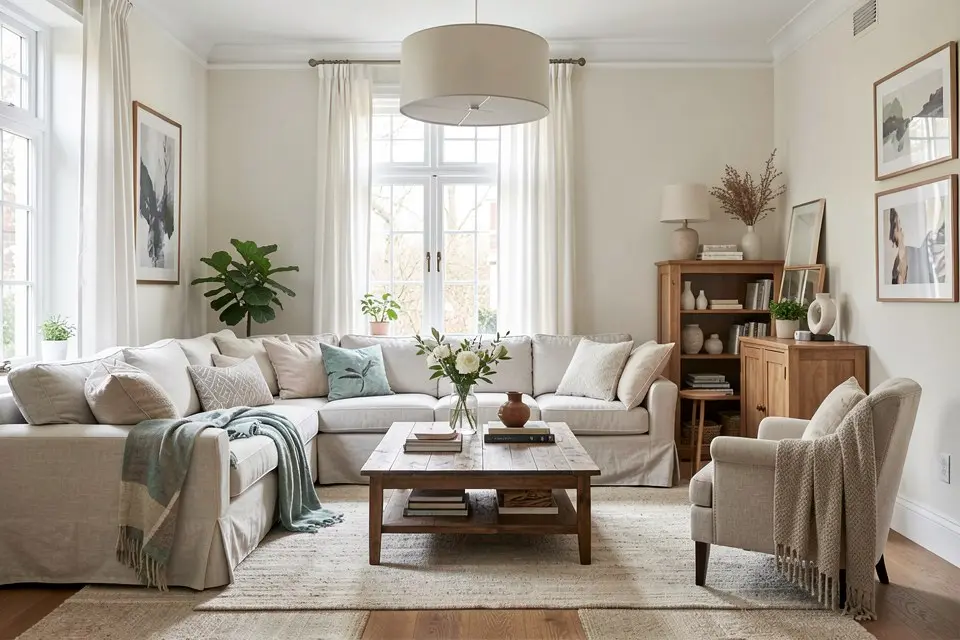
- Favor pieces with visible legs over ones that sit flush to the floor. Furniture with exposed legs lets the eye see floor underneath it, which visually extends the room. The same trick runs through small living room layout ideas for rooms you actually live in. A low platform bed or a skirted sofa blocks that sightline and makes the floor area look smaller.
- Use one large mirror on the wall opposite the window, if the room has one. Mirrors double the apparent light and depth in photos more reliably than almost any other single staging choice.
- Limit color contrast. A small room styled in near-monochrome tones (walls, bedding, and rug within a close tonal range) reads as more continuous and larger than one broken up by strong contrasting colors.
- Skip the second nightstand or the accent chair. In a small room, every extra piece competes for visual space. One nightstand and a lamp usually beats two nightstands and a rug that doesn’t fully fit. In a studio, where the bed shares the frame with everything else, studio apartment layout ideas covers the zoning that keeps the shot readable.
If the room is empty, staging an empty house covers the virtual-first approach, and small apartment redesign ideas has the clearance rules that stop furniture overwhelming the space.
Placement and camera angle
Furniture placement does as much work as furniture choice. Push the bed or sofa toward the corner farthest from the door, rather than centering it on a wall, so the camera can capture the maximum unbroken floor area in the foreground. Angle the shot from the room’s corner, diagonally across the space, rather than straight into a wall; a diagonal shot captures two walls and more perceived depth than a flat frontal one. The rest of the framing rules are in listing photo tips for sellers.
If the room has a window, shoot with the curtains fully open and, where possible, position furniture so it doesn’t block the window from the camera’s angle. Natural light entering unobstructed reads as more space even when the actual square metreage doesn’t change.
Where virtual staging specifically helps small rooms
Because virtual staging tools place furniture digitally at a scale you can control precisely, they’re arguably better suited to small, awkward rooms than physical staging is. A real staging crew working in a genuinely tight room often ends up compromising on furniture size because of what’s actually available to rent; a virtual tool can render a piece at exactly the dimensions that work best for the photo. This is one of the few cases where virtual staging isn’t just cheaper than physical staging, it can produce a better result. For the broader cost comparison, see our guide comparing virtual and physical staging.
A before-and-after checklist
| Change | Effect |
|---|---|
| Swap two small nightstands for one | Reduces visual clutter, opens floor space |
| Add a mirror opposite the window | Doubles perceived light and depth |
| Shoot from the room’s corner, not center | Captures more floor and two walls |
| Choose furniture with visible legs | Extends visible floor line |
| Keep the color palette within one tonal family | Reads as continuous, larger space |
When a room is too small to stage as its labeled use
Occasionally a “bedroom” in an older property is genuinely too small for a bed to meet local minimum dimensions. In that case, don’t force it. Stage it honestly as a home office or nursery instead, since a buyer discovering in person that the “bedroom” barely fits a single is worse for trust than a listing that correctly calls it a flex room from the start.
Try it yourself
Homie generates Virtual Staging at precise, true-to-room scale, which makes it especially effective for small or awkward rooms where getting the furniture size exactly right is the difference between a room that photographs cramped and one that photographs cozy.