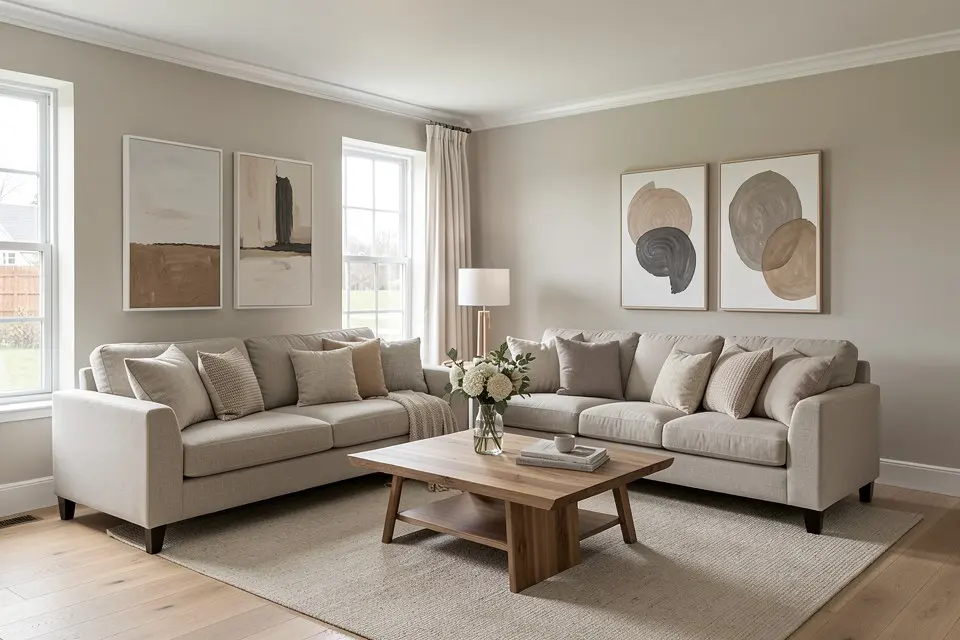
Home staging on a budget means spending in a strict order: remove, clean, repair, light, then add. The first three cost almost nothing and do most of the work; the money goes on light and a few textiles, and virtual staging covers any room you cannot furnish. A lived-in flat can be made ready for photos for €300 – €750 and two weekends. Prices here are rough European ranges and vary by country.
This guide is about allocating a fixed amount of money. For the room-by-room task list, use the home staging checklist for sellers alongside it.
Spend in this order
- Remove (€0 – €150). Take out a third of the furniture, everything personal, and almost everything from worktops, shelves and floors. Costs appear only if you need a van or a month of self-storage (€40 – €150 for 3 – 5 m²).
- Clean (€20 – €250). Windows inside and out, grout, limescale, oven, extractor, skirting boards. DIY supplies cost about €20; a professional deep clean of a two-bedroom flat is roughly €150 – €250.
- Repair (€10 – €100). Filler and touch-up paint, fresh silicone around the bath and sink, a dripping tap, loose handles, a door that sticks.
- Light (€20 – €120). The same colour temperature in every fitting, plus lamps in dark corners.
- Add (€50 – €400). Bedding, towels, a rug, plants, and one or two things per room at most.
- Fill gaps digitally. Empty or badly furnished rooms are staged in the photo.
Each step is cheaper than the next and makes it work better. Buying cushions for a room that has not been cleared is the most common way to waste a staging budget.
Four budgets, four plans
| Budget | Where it goes | What it achieves |
|---|---|---|
| €100 | Cleaning supplies €20, bulbs €25, filler, silicone and touch-up paint €25, two plants and white towels €30 | A clean, bright, repaired home. No new look, but nothing puts a buyer off |
| €300 | The above, plus paint for one room €60, white bedding for the main bedroom €50, a shower curtain and bath mat €25, two lamps €60 | The main bedroom, living room and bathroom photograph well |
| €750 | The above, plus a 160 × 230 cm rug €120, cabinet handles €60, a large mirror €70, a second room painted €60, professional window cleaning €60, storage unit €80 | Every main room is ready, and the home looks cared for |
| €1,500 | The above, plus a professional deep clean €200, a staging consultation €200 – €400, a slipcover or secondhand armchair €150, hallway and front door refresh €100 | Close to what a stager would do with your own furniture |
If professional photos are not included by your agent, they come before anything in the last two rows. A photographer usually charges €150 – €350 for a flat, and staging that is badly photographed is wasted. If you are shooting it yourself, follow the listing photo tips for sellers.
Where each euro works hardest
Bulbs before lamps. Replace every bulb with the same warm white, 2,700 – 3,000 K, and enough output: about 800 lumens (an 8 – 10 W LED) in table and floor lamps, more in ceiling fittings. Mixed cool and warm bulbs make walls look patchy in photos. A pack of six costs €12 – €25. Then add a lamp to any corner that is dark at 16:00; the placement rules in the living room lighting plan apply directly.
White textiles. A white duvet cover and two pillowcases (€30 – €60) on the existing bed, two bath towels and a hand towel in white (€20 – €40), a plain shower curtain (€10 – €20). These are the cheapest things in the house to replace and the ones buyers look at closely.
Paint, selectively. A 10-litre tub of matt white or soft off-white costs €35 – €70 and is roughly enough for two coats on the walls of one average room. Paint the room with the strongest colour or the most marks, not the largest one. The full materials list is in what it costs to paint a room.
The entrance. Buyers decide a lot before they are inside. A clean door, a new mat (€15), a working doorbell and one plant by the door cost under €50. The exterior checklist before selling covers the rest of the outside.
One mirror. A mirror of about 70 × 170 cm leaned or hung opposite a window brightens a dark hallway or small bedroom for €50 – €90, and you take it with you.
Borrow, buy secondhand, or buy to keep
Staging purchases are temporary, so decide what happens to each one afterwards.
- Borrow: lamps, plants, a rug, a small table and chairs for a balcony, art. Friends and family own all of these and need them back in six weeks, which is about how long you need them.
- Buy secondhand, resell after: an armchair, a dining table for a room that has none, a bed frame for a spare room. A €100 piece bought used often resells for close to what you paid.
- Buy new, take with you: bedding, towels, bulbs, a mirror, a rug you would want in the next home anyway.
- Do not buy: furniture to fill an empty room for photos. That is the job for virtual staging.
When virtual staging is the budget option
Three situations make digital staging cheaper than any physical fix:
- An empty room. Renting furniture for one room costs €300 – €900 a month. A staged photo costs a small fraction of that, as the virtual staging cost comparison shows.
- A room with the wrong furniture. A bedroom used as storage, or a dining room that has become a gym. Clear it, photograph it empty, stage the photo.
- A whole empty home. Combine staged photos with a few real items for viewings, as described in how to stage an empty house without renting furniture.
Upload the photo of the empty room to Homie’s Virtual Staging and choose a style that suits the likely buyer. It works from one photo, and a free account gives two designs a day, enough to cover a small flat over a few days. Two rules keep it honest: never use a version that changes windows, doors or floors, and label the image as virtually staged in the listing. The step-by-step version, with the checks for scale and light, is in how to virtually stage a room.
A worked example: 70 m² two-bedroom flat, €400
An owner-occupied flat with a cluttered living room, a main bedroom with dark blue walls and a second bedroom used as a storeroom.
| Item | Cost |
|---|---|
| Self-storage, 3 m², one month, for boxes and four pieces of furniture | €60 |
| Cleaning supplies, grout pen, limescale remover | €25 |
| Filler, silicone, touch-up paint | €20 |
| 12 warm-white LED bulbs | €35 |
| Paint and roller kit for the blue bedroom | €65 |
| White bedding and two pillows | €60 |
| White towels, shower curtain, bath mat | €40 |
| Floor lamp, secondhand | €25 |
| Three plants | €30 |
| Door mat and hallway hooks | €25 |
| Total | €385 |
The rug and a second lamp are borrowed. The storeroom is emptied into the storage unit, photographed empty and virtually staged as a child’s bedroom; for viewings it gets one of the plants and a clean floor. Time: two weekends, plus one evening for photos.
Common mistakes
- Buying decor before clearing. New cushions on a crowded sofa change nothing.
- Spending on rooms buyers skim. Put the money into the living room, kitchen, main bedroom and bathroom, in that order. Utility rooms and spare rooms only need to be clean and empty enough to read as space.
- Adding too much. Three objects on a shelf, one on a bedside table, nothing on the kitchen worktop except a board or a bowl. In compact rooms even less, as staging small rooms for listings explains.
- Strong scents. Air the home for 20 minutes before a viewing in place of plug-in fresheners, which make buyers wonder what is being covered.
- Renovating in place of staging. A new kitchen or bathroom before a sale rarely returns its cost. Handles, silicone and a deep clean do.
- Assuming virtual staging replaces preparation. It fixes the photos. The viewing still happens in the real room; when each approach is worth paying for is weighed in virtual staging vs physical staging.
 Homie