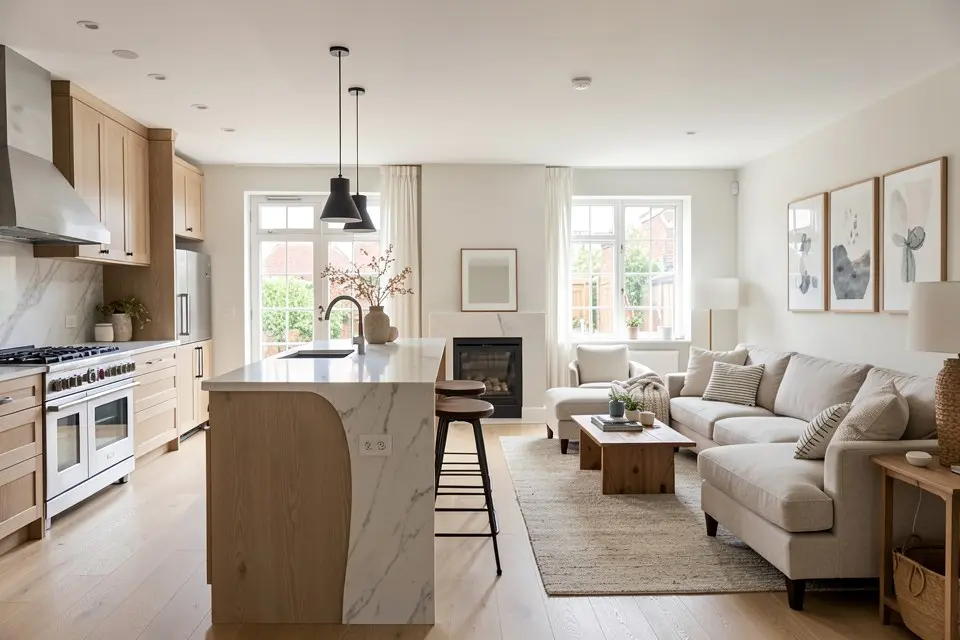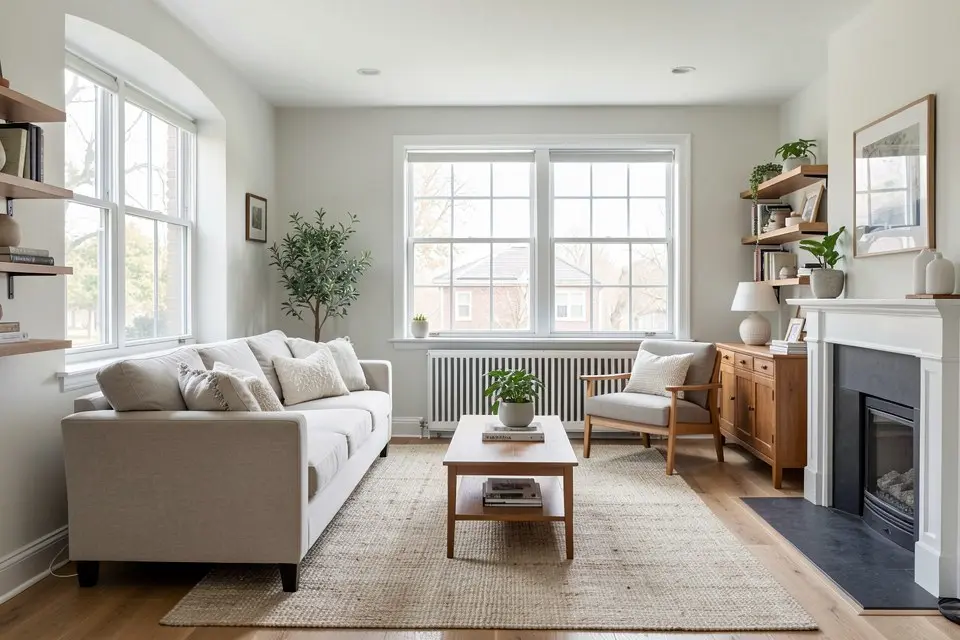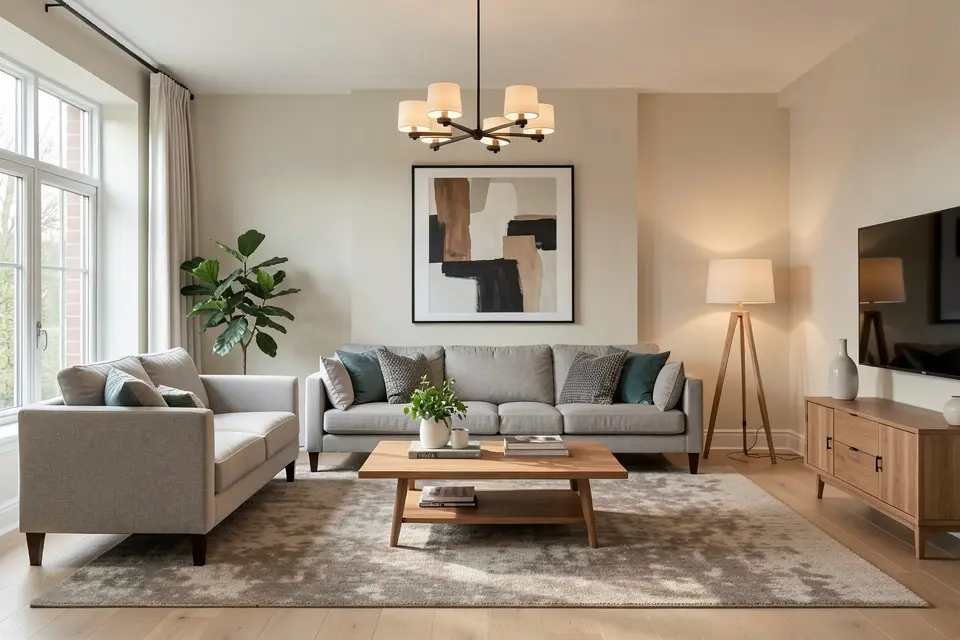
A living room lighting plan comes down to three layers — ambient, task and accent — spread across at least five light sources at different heights, all in warm 2700 K. The typical problem is not too little light but light from one place: a single ceiling fitting that flattens the room, casts shadows under every face and makes the walls look grey. Fix the distribution and the same room looks larger, warmer and more expensive without buying a single new piece of furniture.
Start with the three layers
Every well-lit living room uses the same structure, whatever the style.
- Ambient light is the general fill that lets you walk through the room safely. It can come from a ceiling fitting, recessed downlights, a cove strip or a pair of large floor lamps bouncing light off the ceiling.
- Task light is focused light for doing something: reading in an armchair, working at a desk corner, a game at the coffee table. It is a lamp with a shade that points light down and toward the page.
- Accent light is light aimed at a thing rather than at a person: a picture light over art, an LED strip behind shelves, an uplight in the corner behind a plant.
The mistake most people make is treating the ambient layer as the whole plan. The ceiling light is the one you use least in the evening, when the room is actually lived in. In a good plan it is the layer you switch on to hoover and switch off to sit down.
How much light you actually need
Budget lumens, not watts. For a living room, a total of 100–150 lumens per square metre is comfortable, with the ability to dim down to about a third of that in the evening.
| Room size | Total lumens | Example split |
|---|---|---|
| 12–15 m² | 1,500–2,000 | Ceiling 800, two lamps 400 each, one accent 200 |
| 18–22 m² | 2,200–3,000 | Ceiling 1,200, three lamps 400 each, two accents 250 |
| 25–35 m² | 3,000–4,500 | Downlights or two ceiling points 1,800, four lamps, three accents |
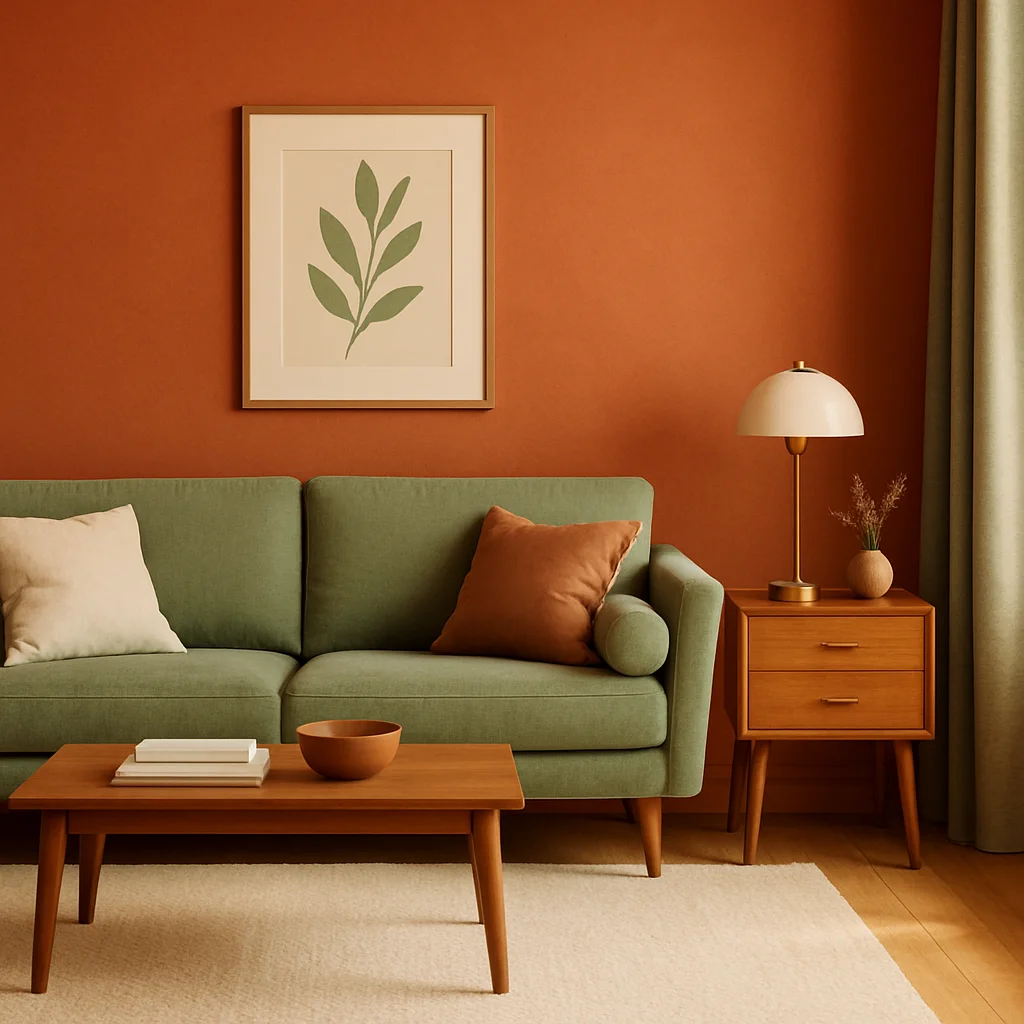
Dark rooms need the upper end: north-facing windows, dark floors, deep wall colours or wood panelling all absorb light. A room painted in a deep accent colour — the kind covered in accent wall ideas — can need 20–30% more output to feel as bright as a white one.
Choose bulbs with a CRI of 90 or higher. Cheap LEDs at CRI 80 make skin look sallow and turn warm wood slightly green; the price difference is usually €2–€4 a bulb.
Colour temperature: keep it warm and consistent
The single fastest improvement in most living rooms is replacing mismatched bulbs. A 4000 K ceiling light next to a 2700 K lamp makes both look wrong: the cool one reads blue, the warm one reads orange.
- 2700 K for ambient and most lamps. This is the default for a living room.
- 2200–2400 K for accent lights and anything you mainly use late in the evening. Some “warm dim” bulbs drop from 2700 K to about 1800 K as you dim them, which mimics candlelight and is worth the €8–€15 per bulb.
- 3000 K as the coolest option for a dedicated reading lamp.
If your wall colour was chosen under daylight, check it again at night under 2700 K. Cool greys and greens shift noticeably; the undertone method for choosing paint explains why and is worth doing before you commit to bulbs and paint together.
Where the lamps go
Think in terms of a triangle of light across the room, at three heights: low (table lamps around 60–75 cm from the floor), middle (floor lamps and wall lights at 150–170 cm) and high (ceiling). Your eye moves between them and the room reads as having depth.
- Beside the sofa. A table lamp on one side table or a floor lamp arching over the end seat. Put the bottom of the shade roughly at shoulder height when seated, about 100–110 cm from the floor, so the bulb is hidden and the light falls on a book.
- Opposite corner. A floor lamp or uplight in the corner diagonally across from the sofa. This is the lamp that makes the room feel wider, because it lights the corner that a ceiling fitting always leaves dark.
- Near the window wall. A small lamp on a sideboard or sill. It balances the black glass after sunset, which otherwise acts like a dark hole in the wall.
- On the media or storage wall. A strip behind or under the TV, or small lamps inside shelving. Light behind a screen reduces eye strain and stops the TV being a black rectangle when it is off.
- On the art. A picture light, a spotlight on a ceiling track, or a plug-in wall washer. One lit object gives the room a focal point at night.
Leave at least one lamp within reach of the sofa so you never have to get up to change the mood. If you are also rearranging furniture, sort the layout first — the ideas in small living room layout ideas decide where the sofa sits, and the lamps follow the sofa.
Controls matter as much as fittings
A plan with five lamps is only useful if you can switch them easily.
- Put table and floor lamps on the switched sockets if your electrician wired any; in many European homes one or two wall sockets are switched from the door. If not, a smart plug at €10–€20 each lets one switch or phone control a group.
- Dim the ceiling light. A compatible LED dimmer costs €25–€60 plus an electrician’s visit of €60–€120. Check that the bulbs say “dimmable”; non-dimmable LEDs flicker.
- Set two scenes, not ten. “Evening” (lamps and accents on, ceiling off) and “bright” (everything on) cover most of real life.
What it costs
Most living rooms can be relit without touching the wiring.
| Level | What you get | Typical cost |
|---|---|---|
| Bulbs only | Replace every bulb with matching 2700 K, CRI 90+ | €40–€90 |
| Lamps added | Two new lamps, one LED strip, smart plugs | €150–€400 |
| Full plug-in plan | Four to five lamps, picture light, warm-dim bulbs | €400–€900 |
| Wired changes | Dimmer, extra wall lights or downlights, fitted | €600–€2,500 |
Recessed downlights look clean in magazines but are the most expensive layer and the easiest to overdo. Six downlights in a grid give you a well-lit ceiling and still no light at eye level. If you add them, put them 50–70 cm from the walls to wash the walls rather than the floor, and keep the lamps anyway.
Before buying fittings, it helps to see the room with a different lighting mood. A photo run through Homie’s Room Redesign with an “evening, warm lamp light” prompt shows whether the room wants more corner light or a lit wall, and it takes a minute rather than a weekend of returns. If lighting is part of a larger refresh, the broader living room redesign ideas cover the order of moves.
Common mistakes
- One big ceiling pendant as the whole plan. It lights the top of heads and the floor, not faces or walls.
- All lamps at the same height. Five table lamps on five tables still read as one layer. Mix low, middle and high.
- Bare bulbs at eye level. Any exposed bulb within a seated person’s line of sight causes glare. Use shades or opal diffusers.
- Cool white LED strips. A 6500 K strip behind the TV makes the whole wall look like a shop window. Use 2700 K or warmer.
- Ignoring the corners. Dark corners shrink a room by visually pulling the walls in.
A worked example
A 4.2 × 5 m living room (21 m²), north-facing, with oak floors, off-white walls and a single 60 W-equivalent ceiling pendant. The sofa sits against the long wall facing the TV.
The ceiling pendant stays but gets a 1,200-lumen dimmable bulb and a dimmer switch (€45 plus €90 fitted). An arc floor lamp goes over the left end of the sofa with a 2700 K bulb at 800 lumens (€140). A paper floor lamp goes in the far corner by the window (€70). A small ceramic table lamp sits on the sideboard under the window (€55). A 2400 K LED strip goes behind the TV unit (€25), and a plug-in picture light over the print above the sofa (€60). Everything except the pendant runs from two smart plugs (€30).
Total: about €515 and one electrician’s visit. In the evening the ceiling light stays off, five warm sources light the room at three heights, and the room that used to look grey after 5pm now looks like the one in the listing photos.